


-
Eyamin Hossain
- January 8, 2026
- No Comments
Why Your Clarification Strategy Matters Now
If you’re reading this, you’re likely facing one of three stressful scenarios at your facility. Either your municipal surcharges for TSS (Total Suspended Solids) and FOG (Fats, Oils, and Grease) have just skyrocketed, your current treatment system is bottlenecking production, or you’re planning a new facility and need to ensure environmental compliance from day one.
In the world of industrial wastewater treatment, Dissolved Air Flotation (DAF) is often the “silver bullet” for contaminants that refuse to settle. But buying a DAF isn’t like buying a pump off a shelf. It’s a complex process calculation involving hydraulic loading rates, air-to-solids ratios, and chemical pretreatment.
At Hei Environment, we believe that educated buyers make the best engineering decisions. This guide goes beyond the sales brochure. We’re going to break down exactly how DAF technology works, why it outperforms traditional sedimentation for specific industries, and the critical design criteria you need to know before you sign a purchase order.
What is Dissolved Air Flotation
To the uninitiated, a DAF system looks like a tank with a skimmer on top. To an engineer, it’s a precision instrument utilizing Henry’s Law to separate solids from liquids.
The Simple Explanation
Traditional clarifiers rely on gravity to make heavy solids sink to the bottom. But what if your waste is lighter than water? Grease, oil, and fibrous solids float naturally. A DAF system accelerates this natural floating process. It injects millions of microscopic air bubbles into the wastewater. These bubbles attach to the suspended solids, effectively lowering their density and lifting them rapidly to the surface, where they’re skimmed off as sludge.
The Advanced Engineering Explanation: The Science of “Whitewater”
The core efficiency of Dissolved Air Flotation (DAF) Systems lies in the precision generation of “whitewater.” Rather than simple aeration, this process relies on controlled solubility and pressure changes:
- The Recycle Loop: A portion of the clarified effluent is diverted, pressurized, and saturated with air in a specialized saturation vessel.
- Micro-Bubble Formation: When this pressurized water is released into the main tank at atmospheric pressure, the air precipitates out of the solution. This creates a dense cloud of micro-bubbles (typically 30–50 microns).
- Surface Area Maximization: Because these bubbles are microscopic, they provide a massive surface area for attachment, allowing them to “grip” even the finest suspended particles.
Why Custom Design Matters: The Air-to-Solids (A/S) Ratio
A generic, “off-the-shelf” DAF often fails because it ignores the unique specific gravity of your facility’s waste. The effectiveness of the system depends entirely on the Air-to-Solids (A/S) Ratio:
- If the ratio is too low, there isn’t enough buoyant force to lift the solids, causing them to settle and contaminate the effluent.
- If the ratio is too high, you are wasting energy on excess compression and risking turbulence that can shear the chemical floc apart.
Understanding this math is the difference between a system that meets compliance and one that becomes an operational bottleneck. Custom engineering ensures the recycle rate and saturation pressure are tuned to your specific contaminant load.
How the DAF Process Works (Step-by-Step)
We often see clients frustrated because they purchased a DAF, but it’s not functioning properly. Usually, the issue isn’t the DAF itself—it’s the process flow. Here’s the physiology of a successful system:
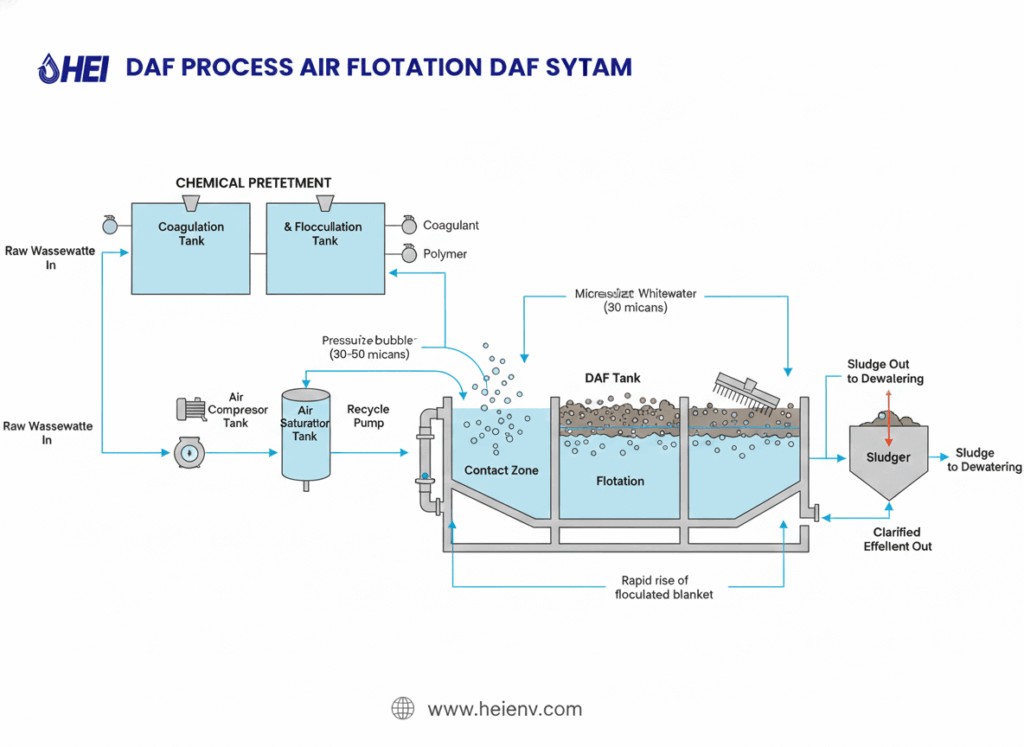
1. Chemical Pretreatment (The Setup)
Before water enters the DAF, it usually needs chemical conditioning.
- Coagulation: We add a coagulant (like Ferric Chloride or PAC) to neutralize the negative charge of the particles.
- Flocculation: We add a polymer to bridge these neutralized particles together, creating larger “flocs.”
Critical Note: Without proper chemistry, the bubbles have nothing to “grab” onto.
2. The Contact Zone
The chemically treated water enters the DAF tank and is immediately mixed with the recycled whitewater. This is the Contact Zone. This is where the physics happens: bubbles collide with and attach to the floc particles.
3. The Separation Zone
As the flow moves into the main separation zone, the bubble-floc agglomerates rise to the surface. This happens much faster than gravity settling—often at rise rates of 4 to 12 gallons per minute per square foot (gpm/ft²)
4. Skimming and Removal
A mechanical skimming assembly (chain and flight or scraper) gently pushes the floating sludge blanket into a sludge hopper. Meanwhile, the clean water (subnatant) flows under a baffle and leaves the system.
Problems Solved & Best Use Cases
DAF systems are not universal. They’re specialized tools. Knowing if you’re the right candidate is crucial for your budget.
Who is DAF Best For?
DAF is the gold standard for industries producing waste that’s light, oily, or fibrous.
- Food & Beverage Processing: Snack food production, dairy, and meat processing generate high levels of FOG and biological solids that float. DAF can typically remove 90-99% of these contaminants.
- Pulp & Paper: Fiber recovery is essential here; fibers float easily and can often be reused.
- Cosmetics & Pharmaceuticals: Manufacturing creates wash-down water with surfactants and light organic soli
What Problems Does It Truly Solve?
Surcharge Reduction: If your local municipality charges you for every pound of TSS and BOD (Biological Oxygen Demand) over a certain limit, a DAF can pay for itself in 12–24 months purely on savings.
Space Constraints: Because DAFs operate at high hydraulic loading rates, they have a much smaller footprint than sedimentation clarifiers. If you’re retrofitting a plant in a tight US industrial park, DAF is often the only option that fits.
Process Water Reuse: Many facilities use DAF effluent as wash-down water, drastically cutting their fresh water consumption.
Who Should Avoid DAF?
If your primary contaminant is sand, grit, or heavy metals that sink like a stone, a DAF is the wrong tool. You’re fighting physics trying to float a rock. In these cases, a traditional clarifier or gravity settler is more efficient and cheaper.
Decision Making – Realistic Expectations & Costs
Competitors will tell you their DAF works “like magic.” We prefer to tell you the operational reality so you can plan your OpEx (Operational Expenditure).
Realistic Removal Rates
While marketing brochures promise 99.9%, real-world performance depends on operations.
- TSS Removal: Expect 85% – 95%
- FOG Removal: Expect 90% – 98%
BOD Removal: DAF only removes insoluble BOD (associated with solids). Soluble BOD (sugar dissolved in water) will pass right through a DAF. Don’t buy a DAF expecting to remove soluble BOD without biological treatment downstream.
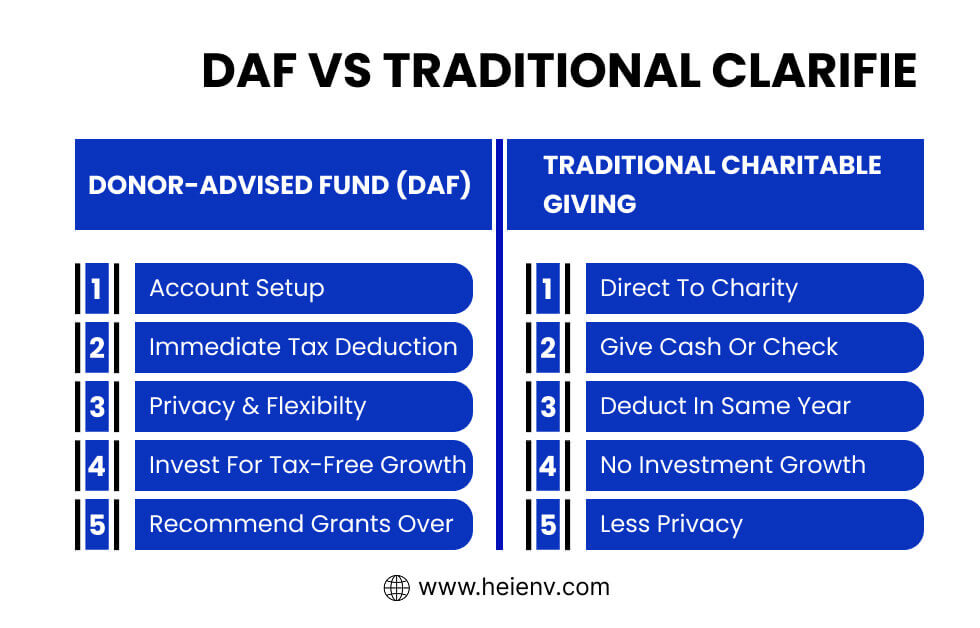
DAF vs. Traditional Clarifier (Sedimentation)
| Feature | Dissolved Air Flotation (DAF) | Traditional Clarifier |
| Footprint | Compact (Small) | Large |
| Solids Type | Light, Oily, Grease, Fibers | Heavy, Settleable, Grit |
| Start-up Time | Fast (30–60 mins) | Slow (Hours/Days) |
| Sludge Dryness | Higher (2–5% solids) | Lower (<1% solids) |
| Energy Cost | Higher (Pumps + Compressors) | Low (Gravity driven) |
| Chemical Use | Usually Mandatory | Sometimes Optional |
The “Hidden” Costs
The capital cost (CapEx) of the stainless steel tank is one thing. But you must factor in:
- Chemical Consumption: Polymers and coagulants are ongoing costs.
- Sludge Handling: DAF sludge is thick. You need a plan to dewater it (filter press) or haul it away.
Power: The recycle pump runs 24/7.
Local Context – Why Compliance Matters in the USA
Operating in the United States presents specific regulatory hurdles that make DAF systems increasingly relevant in 2026.
The EPA and Local POTW Limits
Across the US, Publicly Owned Treatment Works (POTWs) are tightening their local limits. Aging municipal infrastructure cannot handle high-strength industrial loads.
The Trend: Cities are moving from simple surcharges to strict “desist” orders for repeat violators of FOG limits.
PFAS Concerns: While DAF alone isn’t the total solution for PFAS, it’s often the first step in a treatment train required by new state-level regulations emerging in states like California, Michigan, and throughout the Northeast.
Why “Made in USA” Design Matters
At Hei Environment, we design systems specifically for US compliance standards. Imported, cookie-cutter units often fail because they’re designed for different voltage standards or use metric components that are difficult to replace quickly during a breakdown in Texas or Ohio. We prioritize standard US components (motors, pumps, drives) so your maintenance team isn’t waiting weeks for a part.
Critical Design Criteria You Need to Know
If you’ve determined that DAF makes sense for your application, understanding the key design parameters helps you evaluate proposals and avoid undersized or poorly configured systems.
Air-to-Solids Ratio
This fundamental parameter determines whether you’ll have enough dissolved air to float the solids in your waste stream. It’s expressed as pounds of air per pound of solids. Most systems are designed for ratios between 0.01 and 0.10, with 0.03 being a reliable middle ground.
Recycle Ratio
This is the percentage of clarified effluent that gets pumped through the saturation system. Typical recycling rates range from 15% to 30% of the forward flow. Highly concentrated waste streams may require higher recycle ratios to achieve the necessary Air-to-Solids ratio.
Hydraulic Loading Rate
This is simply the flow rate divided by the tank surface area. For circular DAF designs, hydraulic loading rates of 4 to 6 gallons per minute per square foot are typical. The hydraulic loading determines rise time, whether bubbles and attached particles have enough time to reach the surface before being swept out with the effluent.
Solids Loading Rate
This parameter relates the total mass of solids entering the system per hour to the effective surface area of the flotation cell. Conservative designs stay below 2.0 lb/hr/ft², while high-rate systems may push to 3.5 lb/hr/ft². You cannot size a DAF based on flow rate alone. You must calculate the Solids Loading Rate (lbs of solids per square foot per hour) and the Hydraulic Loading Rate (gpm per square foot).
Saturation Pressure and Temperature
Most DAF systems operate at pressures between 60 and 90 psig, with 75 psi being common. The amount of air that dissolves is directly proportional to pressure (Henry’s Law) and inversely related to temperature. At 75 psi and 70 degrees Fahrenheit, water absorbs approximately 9 percent air by weight.
Contact Zone Design
The mixing chamber where pressurized recycle meets conditioned influent is critical but often overlooked. This zone needs enough residence time for bubbles to attach to particles, typically 15 to 60 seconds,s but not so much time or turbulent mixing that flocs get sheared apart.
Material Construction
Wastewater can be highly corrosive depending on pH, temperature, and dissolved chemicals. Carbon steel with protective coatings works for many applications, but may corrode over time. Stainless steel (typically 304 or 316 grade) offers superior corrosion resistance and longer service life but costs significantly more upfront.
Common Implementation Challenges
Even well-designed DAF systems face operational challenges. Understanding these issues upfront helps facilities avoid surprises and maintain consistent performance.
Chemical Optimization
Getting the chemical program right takes time and testing. What works in jar tests doesn’t always translate perfectly to full-scale operation. Facilities should expect a commissioning period of several weeks to months, where chemical types, doses, and injection points are refined.
Temperature Variations
Cold weather affects both chemical reactions and air solubility. Flocculation slows in cold water, requiring higher chemical doses or longer reaction times. Simultaneously, cold water dissolves more air, which sounds positive but can actually create operational issues if the system wasn’t designed with enough margin.
Foam Formation
Excessive foam on the DAF tank surface usually indicates surfactants in the influent, protein-rich wastewater, or chemical incompatibility. Some foam is normal and actually helps form a cohesive float blanket that’s easier to skim. But excessive foam spills over tank walls and creates operational headaches.
Why is My DAF Effluent Cloudy?
Cloudy effluent usually indicates a chemical failure, not a mechanical one. Either the pH is wrong, the coagulant dose is too low, or the “favorable” floc is shearing before it floats. It requires a jar test to diagnose.
Common Questions: Solving Industrial Wastewater Challenges with DAF
These are the most common questions engineers and plant managers ask us, answered plainly.
What is the difference between DAF and Cavitation Air Flotation (CAF)?
DAF uses dissolved air (pressurized water releasing bubbles), creating micro-bubbles (30-50 microns) ideal for delicate solids. CAF uses a mechanical aerator to spin air into the water, creating larger bubbles. DAF is generally more efficient for fine solids and strict discharge limits; CAF is simpler but less efficient.
How do I size a DAF system?
You cannot size a DAF based on flow rate alone. You must calculate the Solids Loading Rate (lbs of solids per square foot per hour) and the Hydraulic Loading Rate (gpm per square foot). High solids loads require a larger surface area, even if the water flow is low.
What is the ideal recycle rate for a DAF?
Standard design usually calls for a recycle rate of 15% to 30% of the forward flow. Highly concentrated waste streams may require higher recycle rates to achieve the necessary Air-to-Solids ratio.
Can DAF systems handle variations in wastewater flow rate and composition?
DAF systems can accommodate moderate variations with proper design and control systems. Flow equalization tanks ahead of the DAF help smooth out peak flows. Automatic chemical dosing systems adjust to changing TSS concentrations. However, extremely variable waste streams challenge any treatment system and may require more extensive flow equalization.
Can DAF systems treat wastewater for reuse in industrial processes?
DAF can be an effective first step in water reuse systems. The clarified effluent from DAF typically has low suspended solids and reduced organics, making it suitable for further treatment through sand filtration, membrane systems, or disinfection. Many industrial operations use DAF effluent for non-contact cooling water or landscape irrigation.
Decision Guide: Is DAF the Right Solution?
Choosing the right clarification strategy is a balance of physics and economics. Use this engineering checklist to evaluate Dissolved Air Flotation (DAF) Systems for your facility:
Ideal for DAF if:
- Contaminant Profile: You manage light, oily, or fibrous solids (FOG, grease, or buoyant biological flocs).
- Operational Footprint: You face strict space constraints or need to retrofit within an existing US industrial park.
- Financial Pressure: High municipal surcharges for TSS/FOG are impacting your bottom line.
- Sustainability Goals: You require high-quality effluent for water reuse or irrigation.
- Agility: You need fast startup/shutdown times (30–60 minutes) compared to gravity settlers.
❌ Reconsider DAF if:
- Heavy Loading: Primary contaminants are dense grit, sand, or heavy metals that naturally sink.
- Soluble Load: You have high dissolved BOD (sugars/alcohols) with no particulate matter.
- Resource Limits: You have a very restricted budget and zero energy or space constraints (gravity may be cheaper).
Conclusion: Engineering Your Regulatory Firewall
A DAF system isn’t just “equipment”, it’s the only thing standing between your production line and a “Cease” order. When engineered correctly, it’s a profit center. When guessed at, it’s a bottleneck.
Why HEI Environment? 40 Years. 1,000+ Systems.
Since 1978, HEI has operated with a single philosophy: We design, build, and install each piece of equipment as if we were going to use it ourselves. As a registered Professional Engineering Firm, we assume total process responsibility from feasibility to final installation.
- Proven Track Record: Over 1,000 industrial wastewater systems installed worldwide over the past 40+ years.
- In-House Manufacturing: Based in Conroe, Texas, we control the entire lifecycle of your project, providing a significant competitive advantage in quality and lead times.
- Total Accountability: We offer the ability to post treasury-rated performance bonds for major projects, guaranteeing that our systems meet your specific removal rates.
- Turn-Key Excellence: Our capabilities include feasibility studies, custom fabrication, and on-site start-up, ensuring your team is trained and your plant is compliant from day one.
Next Steps for Your Facility:
Ready to analyze your effluent? Review our DAF Design System Criteria or contact our engineering team today for a treatability study to see exactly what removal rates you can achieve.